The identifiers behind the TA1 label
Oath Thymosin Alpha 1 has a 28-residue sequence with an acetylated N-terminus. The names-and-identifiers table groups the compound’s CAS entry, elemental formula and average molar mass, while keeping the vial size separate. The formula describes the molecule; the mg figure describes the amount listed for a vial at Oath.
| Identifier | Value |
|---|---|
| Oath product name | Thymosin Alpha 1 |
| Identity name | Thymalfasin (listed by Oath as Thymosin Alpha 1) |
| Abbreviation | TA1 |
| CAS number | 62304-98-7 · ChEBI 135915 |
| Molecular formula | C129H215N33O55 · ChEBI 135915 |
| Average molar mass | 3108.315 g/mol · ChEBI 135915 |
| Residue count | 28 |
| Sequence record | DRAVP DRAVPc009 |
| Named modification | N-terminal acetyl group |
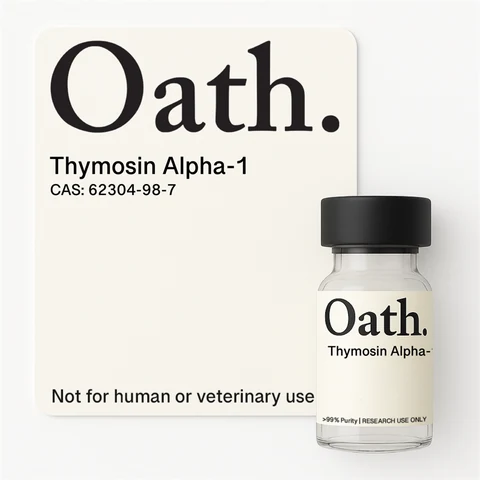
ChEBI 135915 identifies the database entry associated with the CAS, formula and average mass shown here. DRAVP DRAVPc009 identifies the sequence entry. These record identifiers distinguish the chemical entries from a laboratory’s batch number. The CAS number printed on Oath’s pictured packaging is also 62304-98-7, matching the tabulated identifier.
Read the chain in residue order
The complete one-letter sequence is SDAAVDTSSEITTKDLKEKKEVVEEAEN. Positions start at the N-terminal serine, continue through the chain and finish at asparagine in position 28.
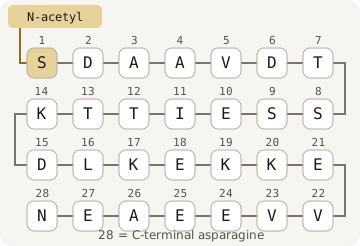
The table gives each position with its one-letter abbreviation, three-letter abbreviation and full residue name. S, for example, denotes Ser, or serine; N denotes Asn, or asparagine. The modification column identifies the acetyl group at the first residue. A dash leaves the other positions unmarked.
| Position | Residue | Modification |
|---|---|---|
| 1 | S · Ser · Serine | N-terminal acetyl group |
| 2 | D · Asp · Aspartic acid | — |
| 3 | A · Ala · Alanine | — |
| 4 | A · Ala · Alanine | — |
| 5 | V · Val · Valine | — |
| 6 | D · Asp · Aspartic acid | — |
| 7 | T · Thr · Threonine | — |
| 8 | S · Ser · Serine | — |
| 9 | S · Ser · Serine | — |
| 10 | E · Glu · Glutamic acid | — |
| 11 | I · Ile · Isoleucine | — |
| 12 | T · Thr · Threonine | — |
| 13 | T · Thr · Threonine | — |
| 14 | K · Lys · Lysine | — |
| 15 | D · Asp · Aspartic acid | — |
| 16 | L · Leu · Leucine | — |
| 17 | K · Lys · Lysine | — |
| 18 | E · Glu · Glutamic acid | — |
| 19 | K · Lys · Lysine | — |
| 20 | K · Lys · Lysine | — |
| 21 | E · Glu · Glutamic acid | — |
| 22 | V · Val · Valine | — |
| 23 | V · Val · Valine | — |
| 24 | E · Glu · Glutamic acid | — |
| 25 | E · Glu · Glutamic acid | — |
| 26 | A · Ala · Alanine | — |
| 27 | E · Glu · Glutamic acid | — |
| 28 | N · Asn · Asparagine | — |
What the sequence letters specify
Reading from positions 1 to 7 gives S-D-A-A-V-D-T. Positions 8 to 14 continue S-S-E-I-T-T-K; positions 15 to 21 are D-L-K-E-K-K-E. The final seven positions are V-V-E-E-A-E-N. Follow the numbered connectors across each row.
Repeated letters occupy separate numbered positions: alanine appears at positions 3, 4 and 26, for instance. Glutamic acid appears at 10, 18, 21, 24, 25 and 27. The residue count totals the 28 letters. The N-terminal acetyl group is indicated alongside the chain rather than counted as another amino-acid residue.
The formula C129H215N33O55 expresses the numbers of carbon, hydrogen, nitrogen and oxygen atoms in the recorded molecule. The accompanying 3108.315 g/mol value is an average molar mass. These identifiers describe the acetylated sequence as a chemical entity and stay the same across the vial sizes listed for this product.
Oath’s form and package information
Oath lists white to off-white lyophilized powder, with vial sizes 5 mg, 10 mg. The starting price is $90.00 before shipping. The Shop at Oath button opens the product page, where the vial size can be selected. Molecular mass in g/mol and vial contents in mg answer different specification questions.
The TA1 coupon page shows the starting-price entries for SUPER and SUPER15. For package or naming questions, the TA1 FAQ keeps those details alongside the certificate and ordering answers.
From chromatographic peak to purity figure
HPLC-UV separates components on a column and records them with a UV detector. The main peak’s area is expressed as a share of the total integrated peak area. That percentage is the chromatographic purity figure, so its method belongs beside the number when reading the certificate.
Mass spectrometry confirms molecular mass by measuring ion mass-to-charge ratios. An identity entry names the measurement applied to the sample when the certificate states one. The TA1 public record specifies HPLC-UV for purity; its method should be read directly rather than extended to additional measurements. The TA1 certificate fields give the documented batch, laboratory and date on record.